Gregory
Daniel Goldin describes his first session as a therapist.

The following is an article in a soon-to-be-published issue of Psychoanalytic Inquiry, titled “Early Formative Experiences that Contribute to a Psychoanalytic Sensibility,” edited by John R. Paddock Ph.D. ABPP LLC and Sandra Hershberg, M.D.
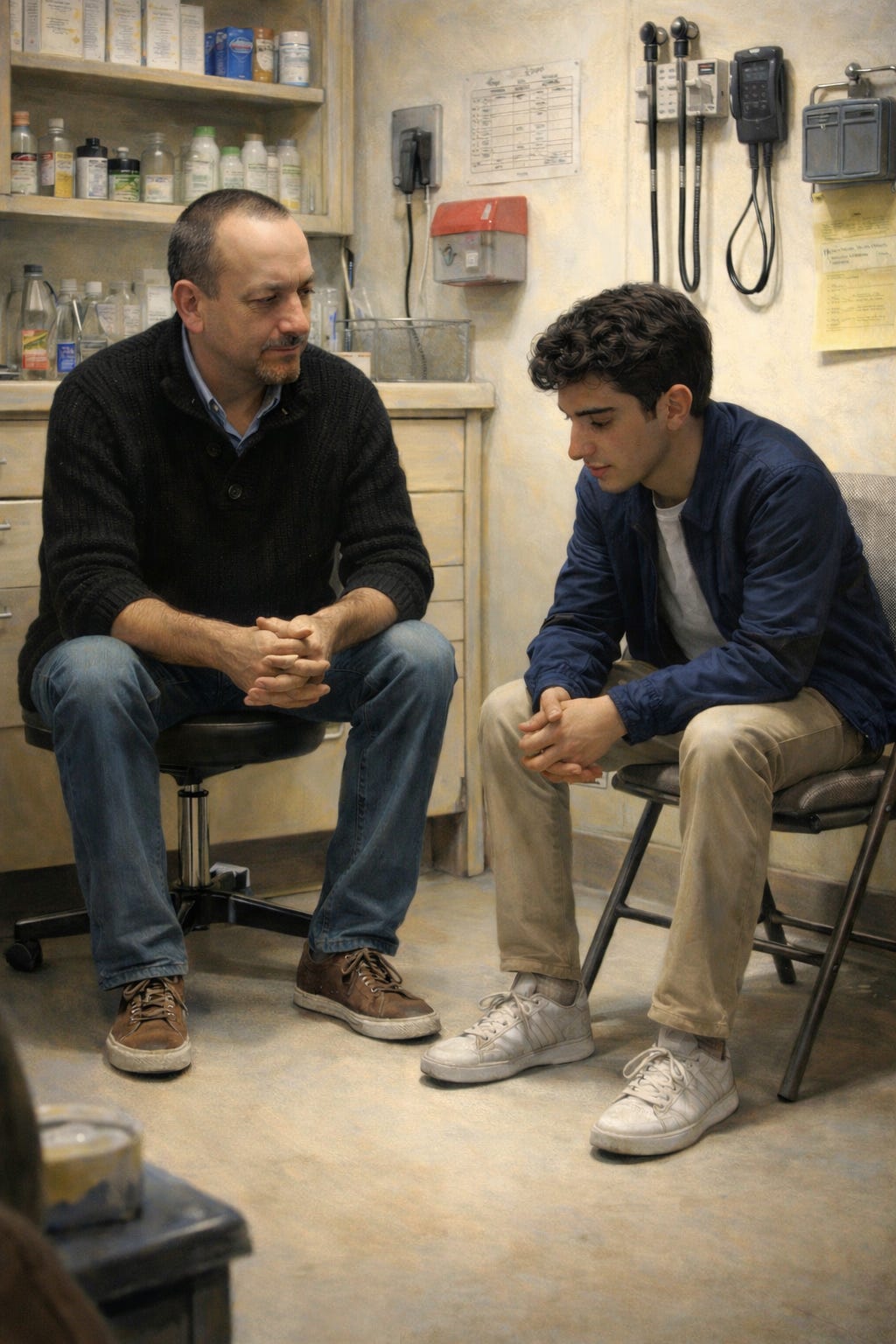
My first patient was a college kid (we’ll call him Gregory) at Glendale Community College. At the time, I was working as a pre-licensed intern at the Glendale Community Counseling Center. “Counseling Center” is a bit of a misnomer, as is the label “intern.” The supervision at the Glendale Community College consisted of a weekly meeting with a small group of psychology students who were seeing patients for the first time. At this meeting, the program director went over bureaucratic guidelines around intake forms and pretty much left it at that. The counseling center was whatever office happened to be available in the nurse’s suite; in this case, a small, chaotic room with two chairs facing each other, cramped around an IV station, a first aid cabinet, and a blood- pressure monitoring stand – symbols of disease-and-cure medicine.
Even after two years of classes, I had no clear idea what was expected of me, but in this room, I felt pressured to perform some conversational procedure equivalent to taking vitals and binding wounds. In panic, I scoured through my knowledge of the DSM II, the voluminous compendium of mental health diagnostic criteria based on itemized symptom lists, even though I was skeptical of its use even at this prehistoric period of my career and knew it would be impossible to hold a 900-page document in mind while talking to a real person. Every soldier finds God in a foxhole. I looked at the DSM before my first session.
I took up psychotherapy as a profession when I was 36. For the first fifteen years of my adulthood, I made a living writing and rewriting screenplays for the Hollywood studios in partnership with my brother. Our initial audience was always a hierarchical team of studio executives whose expertise lay in predicting, through focus groups and the zeitgeist of their peers, the ever-changing taste of movie-goers throughout the world. The final audience consisted of those movie-goers. I had grown to love the screenplay form: the art of describing moving images in such a way that they would play in the reader’s mind at a speed analogous to the speed of film; the art of designing dialogue to evoke, rather than display, the intentions of characters, often at cross-purposes, self-and-other-deceiving and moving fast, along with the audience, toward a shifting outcome in doubt till the last action-image or spoken word. Movies are all about timing and emotion, more like symphonies than novels. Every writer operates in a space between the new and the familiar, an originator and medium at once.
Unexpectedly, that space felt increasingly cramped as I got to understand the politics of Hollywood and began to perceive with more clarity what the people hiring me wanted, and after a decade of screenwriting, I was putting my knee around my neck trying to fit into that space. I was no longer a good originator, and I was becoming an unconvincing medium too; one has to be good at both to be good at one. Some writers in Hollywood are able to find that sweet spot, but I could not. I think I needed a smaller audience and less money at stake to write freely.
At the time that I was experiencing this crisis of faith in my writing, I started seeing a therapist to help me deal with the dissolution of my marriage, or perhaps with dissolution in general, given these twin crises. He was an older psychoanalyst from Chicago, with crisp white hair and a way of understanding with me while staying a step ahead of me. Our conversations worked their way into my life, although I’d be hard-pressed to say in what way. On the most superficial level, I began to feel that there were more possibilities for me in the world. The one implicit ask in that room was to be honest, but it was even okay if I wasn’t; we would get there. I often wondered what it would be like to be opposite someone like me, to do what it was that this man did. Much of my talk in therapy involved plotting my escape from Hollywood. I was surprised to find myself stuck in my current identity of screenwriter. I had written my first screenplay with a feeling of light irony. Now I wondered what I could do other than be a screenwriter? My need to find another career and my contemplation of switching seats with my therapist ultimately converged, and I decided I would find out what it was like to talk in this special way to someone like myself. This was a giant leap of faith for me because I still hadn’t figured out what my therapist did in these conversations that felt so valuable. They weren’t like regular conversations, but weren’t so unlike regular conversations. Graduate school did not do much to clarify matters. I studied the DSM, the brain, and various theories, but nothing seemed to come close to describing my experience of being in concentrated conversation with this wise-seeming older man.
And so here I was sitting opposite 20-year-old Gregory, not knowing what to do. To my surprise, Gregory started talking. He told me he felt anxious, that he couldn’t study, and got distracted by a million things. From the staccato way his words gusted out, I could tell that he hadn’t told anybody about such matters until me. But who was I to him? I realized that my role preceded me and supported us, that I slipped into the outline of “a psychotherapist” as soon as Gregory sat down opposite me, even amidst the chaos of medical equipment. And Gregory, too, slipped into a role that preceded him and supported us, the role of psychotherapy patient. Maybe “roles” is the wrong word. We were in a situation that preceded and supported us, a situation that sustained honest disclosure. As Gregory spoke, I was struck by the idea that he had something more to say that wasn’t being said. I wondered about this “more.” What did I need to know to get at this “more?” My mind wondered about the room where he had these distressing experiences of being distracted. Perhaps, I got to this idea because I was feeling some distress in the room I was in right now. Rooms matter. I recall him describing his bedroom in a small house in Glendale. Gregory’s father had been an accountant in Tehran, but he hadn’t been able to make it in America, beyond helping a few charitable friends with their taxes. Gregory described the TV as being on all day, with the sound of CNN pundits muttering incessantly in the background. His mother was intensely nervous about Gregory and knocked on his door frequently throughout the day, worried that he wasn’t eating enough, wasn’t getting enough exercise, and was not doing enough of whatever. Gregory described feeling hollowed out by her worries. His mother worried about Gregory, but also talked to him in monologues about trivial worries and problems in her day- to-day life. Gregory had the impression that she was staring at a place inside herself, a place full of worry and uncertainty, and every once in a while, she would peek up at him and really see him. Still, perhaps she was just checking to see that he was following her inward gaze, because if she detected his straying attention, she would ask with irritation if she was boring him. Then, she would go back to her monologue and that place inside herself. Both his parents spoke broken English at home, as they had not wanted their son to feel marginalized in his adopted country – but this sacrifice on his behalf only made him feel their loss as something he did not share. He told me he felt far away from his parents. I imagined him trying to study with this background buzz in the back of his brain, knowing every foothold of knowledge was a climb away from his parents. Gregory described when his parents got a call from an old friend in Tehran. He listened to them speak Farsi, a language he didn’t know. His father laughed and gestured with his hands in a way Gregory had not seen before. His mother seemed relaxed and humorous. His parents were at home in this language, in a way they weren’t at home with him, speaking a foreign English. As I continued meeting with Gregory, I sometimes wondered if we were playing this therapy game correctly. We were going with the grain, or so it felt to me, a movement toward that “more?” that I sensed we both needed to get at, but it had little to do with identifying feelings in a direct way, nor with correcting cognitive distortions, nor with tracing current repetitive patterns to infancy – the methods taught in graduate schools. We were storying together. But not in a way that aimed to produce a complete story and be done with it. We were working psychic muscles that came into action automatically when we faced one another, every verbal expansion an undoing of an emotional knot, even when the story’s moral was not optimistic.
I don’t recall now how exactly we got to these stories that had to do with my patient’s distractedness while studying, but I know from more than a decade of doing psychotherapy that the process no doubt involved my guessing my way into Gregory’s life–world by finding intersections in my own life-world, following emotional schemas whose content was radically different but whose essence was similar. I am quite sure that I was often wrong in my guesses, but I have found that being wrong often brings out unexpected aspects of a situation as long as the patient believes my objective in guessing is not to be right but to understand more. Gregory began “to feel better,” meaning that he was freed up in his strivings forward in his life. Freud saw the mind as a psychic energy system and psychoanalysis as a process that manages the distribution of psychic energy. This idea has been much criticized as antiquated and overly mechanistic, but as a metaphor, it still has something to recommend it. Patients in psychotherapy tend to feel freed up in their movements through the world, their energy less bound up in semi-conscious struggles. But that tells only half the story. I believe I have gotten better at doing psychoanalysis over the last 35 or so years, but what I learned in that first session, I still believe. Psychotherapy of the analytic kind is a practice in the way meditation is a practice. People may feel better afterward, but that cannot be the object if it is to work. It is not an instrumental practice. And yet we know we are pursuing something of great meaning. That we don’t quite know what that something is may well be the point.
This is a really beautiful account. I will share it with some of my own clients who are newer therapists. I think they will really appreciate it. It also helps me as well to remember some of the important things. I like the idea of wrong guesses being okay if the idea is to understand better. Thanks for this!
This takes me back to the early days of my own journey as a Psychotherapist. I was not a psychoanalyst per se. I did study psychoanalytic psychotherapy at the Wright Institute of Los Angeles, a.k.a. WILA. Unfortunately, that graduate school went bankrupt before I was able to finish my graduate school tenure and I had to transfer over to CSPP. These are places that are probably familiar to you since I grew up in the San Fernando Valley as well. I started out as a registered nurse, and after my children were born and were in school, and I began to feel the urge to do something outside of the home, I decided that what I really wanted to do was psychotherapy. The whole experience was tremendously beneficial to me both on a personal level, but also a professional level, and I dare say beneficial to the people that I provided that service to. I ultimately ended up working for the veterans health agency VHA in the birthing of the women veterans healthcare center at the greater 🥰VHA greater Los Angeles healthcare system. This is something that had never existed before in the life of the VHA, any kind of real attention to the healthcare and psychological needs of women who had served in the military. So we were quite literally on the cutting edge and we were one amongst eight or nine facilities that had received special funding from Congress to create this comprehensive women’s healthcare center, which embedded the mental health provider inside the primary care clinic for women who had served and also non-veteran women. My area of expertise was what came to be known as military, sexual trauma or MST. I had previously worked for about 4 1/2 to 5 years in the Vietnam Vet Center seeing Vietnam veterans who had served in combat and most of them who had never received any services for their PTSD symptoms for so many decades. Well, I’m gonna cut this very long story a little bit shorter and say that all of that has been an invaluable experience to me and the one thing I love the most about being a Psychotherapist is providing service to others who are in great need of someone to be able to do this thoughtfully, sensitively, but also with a certain amount of knowledge and education behind them. Anyway, I look forward to more articles from this particular site and thank you for sharing your own journey.